 This brief text assists students in understanding Ayn Rand's philosophy and thinking so that they can more fully engage in useful, intelligent class dialogue and improve their understanding of course content. Part of the "Wadsworth Philosophers Series," (which will eventually consist of approximately 100 titles, each focusing on a single "thinker" from ancient times to the present), ON AYN RAND is written by a philosopher deeply versed in the philosophy of this key thinker. Like other books in the series, this concise book offers sufficient insight into the thinking of a notable philosopher better enabling students to engage the reading and to discuss the material in class and on paper.

Selasa, 28 Desember 2010
On Ayn Rand
This brief text assists students in understanding Ayn Rand's philosophy and thinking so that they can more fully engage in useful, intelligent class dialogue and improve their understanding of course content. Part of the "Wadsworth Philosophers Series," (which will eventually consist of approximately 100 titles, each focusing on a single "thinker" from ancient times to the present), ON AYN RAND is written by a philosopher deeply versed in the philosophy of this key thinker. Like other books in the series, this concise book offers sufficient insight into the thinking of a notable philosopher better enabling students to engage the reading and to discuss the material in class and on paper. 
The Ethics Of Ambiguity

By exploring the meaning of "existence before essence" and the fundamental reality of choice, Beauvoir presents the reader with a livable program for life in the modern and multiplicit world; namely existentialism. Ethics is both concise and poetic, maintaining a clarity that Being and Nothingness lacks. The Second Sex is essentially an entailment of the ideas explored in this book. Few other philosophers of the 20th century were able to combine practical philosophy and rigorous metaphysics with such eloquence.
This review is from: The Ethics Of Ambiguity (Paperback)
The Philosophy Of Simone De Beauvoir
 Studies of Simone de Beauvoir have mostly concentrated on her literature, her life, and her famous 1949 work, The Second Sex, and the continued emphasis has been on Beauvoir's views on gender. The Philosophy of Simone de Beauvoir places her theory of women's "otherness" in the context of a number of contemporary theories on a similar subject. While gender takes its place among these, Professor Deutscher counterbalances its grip on our memory of Beauvoir's ideas by situating it in the context of our relationship to ageing, to generational difference, and to race and cultural difference. By differentiating the many aspects of "otherness," Beauvoir revisited some of the concepts of reciprocity, ambiguity, and ethics for which she is best remembered.
Senin, 27 Desember 2010
Paris, Capital of Modernity
 Drawing on essays written over the last 30 years, Harvey brings one of the most fascinating and confounding periods of French-or for that matter, European-history into sharp relief. He asserts that two conceptions of modernity were nurtured in Paris in the years after the First Empire-one bourgeois, and the other founded on the idea of the "social republic" geared toward benefiting all classes of citizens. Harvey traces these conflicting movements over the decades leading up to the Revolution of 1848 and charts their reverberations through the final days of the Paris Commune. The book is richly illustrated with over a hundred period photographs and cartoons by Daumier and others, which serve to reinforce the notion of Paris as a city of contrasts in a period of profound change. And Harvey is as comfortable and adept at quoting pertinent passages from the romantic novelists as he is offering detailed economic analyses of real estate and labor market dynamics. By making use of primary sources from diverse disciplines, he offers a thorough examination of the period: he explores, for instance, the role of women and class strictures and the consequences of urban planning and public transportation. The worst that can be said of this exhaustive investigation into the complicated and turbulent era of the Second Empire is that Harvey presupposes an intermediate knowledge of many of the important actors and events. As he weaves the humanities, philosophy, economics and sociology into a detailed tapestry, the author leaves remedial explanations of Parisian and French social movements to the authors listed in a well-annotated bibliography. This is not a problem in and of itself, but readers expecting a breezy history of the "City of Lights" may find themselves overwhelmed by the complexity and depth of this book.
http://www.4shared.com/document/0D0U11Hw/Paris_Capital_of_Modernity.html
Selasa, 09 November 2010
How the Economy Works: Confidence, Crashes and Self-Fulfilling Prophecies
 "Of all the economic bubbles that have been pricked," the editors of The Economist recently observed, "few have burst more spectacularly than the reputation of economics itself." Indeed, the financial crisis that crested in 2008 destroyed the credibility of the economic thinking that had guided policymakers for a generation. But what will take its place?
In How the Economy Works, one of our leading economists provides a jargon-free exploration of the current crisis, offering a powerful argument for how economics must change to get us out of it. Roger E. A. Farmer traces the swings between classical and Keynesian economics since the early twentieth century, gracefully explaining the elements of both theories. During the Great Depression, Keynes challenged the longstanding idea that an economy was a self-correcting mechanism; but his school gave way to a resurgence of classical economics in the 1970s-a rise that ended with the current crisis. Rather than simply allowing the pendulum to swing back, Farmer writes, we must synthesize the two. From classical economics, he takes the idea that a sound theory must explain how individuals behave-how our collective choices shape the economy. From Keynesian economics, he adopts the principle that markets do not always work well, that capitalism needs some guidance. The goal, he writes, is to correct the excesses of a free-market economy without stifling entrepreneurship and instituting central planning.
Recent events have shown that we cannot afford to treat economics as an ivory-tower abstraction. It has a direct impact on our lives by guiding regulators and policymakers as they make decisions with far-reaching practical consequences. Written in clear, accessible language, How the Economy Works makes an argument that no one should ignore.
About the Author
Roger E. A. Farmer is Professor and Chair of the Economics Department at UCLA. The author of six books and numerous journal articles, he is a Research Associate of the National Bureau of Economic Research and of the Centre for Economic Policy Research. He has served as a consultant to the Federal Reserve Bank of Atlanta, the Reserve Bank of Australia, the European Central Bank and the Bank of England. He is a contributor to the Financial Times Economists' Forum and, in 2000, received the University of Helsinki medal in recognition of his work.
Ten Great Economist
 Originally published in 1952, this seminal work is reproduced here with a new introduction by Professor Mark Perlman, a well-known Schumpeterian scholar. The essays, written between 1910-50 were primarily commemorative pieces marking the achievement of a celebrated economist. Those covered include:
* Marx
* Walras
* Menger
* Marshall
* Pareto
* Bohm-Bawerk
* Taussig
* Fisher
* Mitchell
* Keynes
The appendix includes articles on lesser-known economists Knapp, Von Wieser; Von Bortkiewicz.
With the exception of Marx, Schumpeter himself selected the ten main essays for inclusion in this volume and was personally acquainted with all but two of his subjects. Initially considering them unworthy for publication he relented in the face of public demand since the journals in which they originally appeared were difficult to obtain.
The new introduction places this work in its contemporary context and highlights its importance for students unfamiliar with the original.
The Theory of Moral Sentiments (1984)
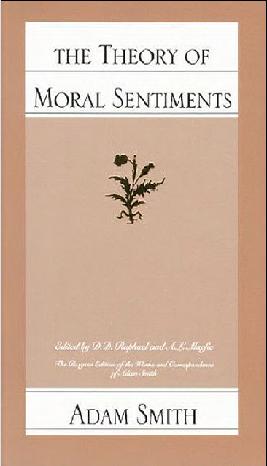 "The Theory of Moral Sentiments" clearly demonstrates that besides mundane economic pursuits, Smith was just as interested, if not more so, in the capacity of people to bestow and to esteem benevolence, and to strive for virtue even while they are pursuing their own self-interest. The root of our motivation to act benevolently toward others, says Smith, is our natural propensity to sympathize with others. By the same token, our need to have others sympathize with us fuels our desire to be esteemed by others for our benevolence and generally virtuous character. But beyond the need for social approbation, we also have a genuine desire to live according to the dictates of conscience (called by Smith the 'Impartial Spectator'). This is our highest impulse and leads us continually to strive for excellence in all spheres of life quite apart from any recognition or encouragement from others. It may be prudent in our economic life to follow our self-interest to secure the basic necessities, but this is only the first stage of personal development toward the much higher goal of living a morally virtuous life. Although "The Theory of Moral Sentiments" is not well known today, it was widely read and highly praised by the leading intellectuals of the day including David Hume and Edmund Burke. The book went through six different editions between 1759 and 1790 and was also translated into French by the widow of Condorcet. To gain a complete picture of Adam Smith and his ideas, every reader of "The Wealth of Nations" should also become familiar with his classic treatment of ethics.
Langganan:
Postingan (Atom)